
 Polski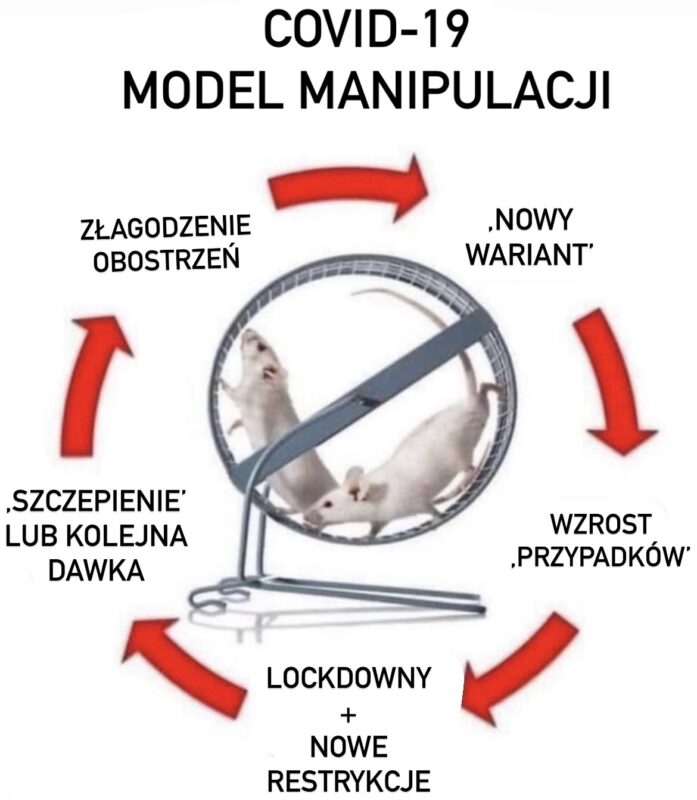
Two years have passed since the first rumors of a new, mysterious, deadly virus and the strangely coincidental games backed by Bill Gates about the planning of a global epidemic, known as Event 201.
For two years, we have watched as the entire playbook of marketing manipulation unfolded, accompanied by the unraveling of a web of lies and the tramping of tyranny that synchronously covered almost the entire globe.
If the ‘most famous doctor in the world’ first says that masks work at most on a psychological level, and a month later he orders people to wear three masks at the same time, then there is no denying that something is wrong.
If a moment later, in his ‘leaked” correspondence, there are implications that he is both the author and the beneficiary of such pandemic scenarios, but instead of being immediately prosecuted, the ‘most famous doctor in the world’ continues to plan further restrictions alongside the president of the world, as if nothing had happened, we should all be seeing red flags all over the place.
But we aren’t. Why?
WHY?
How is it possible that people do not see the lies, manipulation and a complete lack of consistency among the rulers, even if it’s right in their faces?
Why this blindness?
Where does this denial come from?
Don’t people have a shred of respect for their own intelligence?
People who think critically have been asking such questions for two years and still haven’t found the answers.
I was personally very cautious and skeptical about the whole fear-mongering from day one, but I have been dealing with similar issues for years so I instinctively feel when something is fishy.
I understand that for most people this was quite new and it was easy to feel intimidated. Especially at the beginning.
But after a month? Two months? Twelve months??
We know that masks don’t work, but if you’re not wearing one you’re a grandma killer.
We know that the products of genetic engineering, affectionately called vaccines, are not as effective as is loudly claimed (they do not stop the spread of the virus, nor prevent illnesses or deaths), but it is imperative that we sign up for the second, third and millionth dose ‘for the good of humanity’. Or ‘because it’s the right thing to do’.
We know that the criminal and illegal isolation of healthy people, affectionately called a lock-down, does not work, but let’s destroy the economy and send hundreds of thousands of people to their graves prematurely. Because they told us to.
We know that children do not actually get sick, do not die from this particular virus, do not pose a threat to themselves or others, but let’s forbid them from seeing their grandparents, going to school and absolutely force them to get vaccinated. Because… hmmm… vaccinations are good, like candy.
We know that PCR tests are not intended for diagnostics and that a sufficiently high cycle threshold will detect a single molecule even in papaya and engine oil, but let’s still treat their results as revered truth and keep drawing ‘case’ bars.
We know that a disease is recognized by its symptoms, but this disease may not have any yet still be deadly.
We know… but….
Our logic and basic human intelligence is under attack from all sides.
How many draconian but ineffective measures can be taken in the name of ending something that by definition cannot be ended?
Something whose virulence is lower than seasonal flu but will systematically increase in response to our actions?
How long can this go on?
As it turns out – as long as necessary.
I couldn’t understand it myself, I kept wondering how could people be so blind by choice, until a Nice Follower sent me a podcast that explained everything to me.
In podcast #331, Aubrey Marcus talks to Belgian clinical psychologist and statistician Mattias Desmet about why people give up their freedom.
Thanks to his knowledge of statistics, Mattias very quickly noticed that the pandemic prognostic models produced with Gates’ money at Imperial College did not make sense. When analyzing the published numbers of deaths and severe cases of the disease, he concluded that the models clearly exaggerate how virulent the virus is. By May 2020, there was already irrefutable evidence of this.
These forecasts predicted that in a country like Sweden, without a lock-down, 80,000 people would die by the end of May.
Sweden did not introduce a lock-down, and by the end of May 6000 people had died, i.e. the model’s prediction was inflated by a factor of 13, or by about 93% 😉
So when it was proven beyond a shadow of a shadow of a doubt that this original model was completely wrong, the restrictions should have been lifted.
Meanwhile, they were maintained, even tightened over time, as if the erroneous models were one hundred percent correct.
For Mattias, it was a clear indication that a deadly serious mind game was taking place.
Another thing that caught Mattias’ attention was the fact that politicians decided to completely ignore the economic and social costs of the introduced restrictions. In a rational approach, the benefit and risk calculation should be taken into account. It would have been appropriate to ask whether the planned restrictions might cause greater human losses than the virus itself.
Even the UN warned that more people would die of starvation as a result of the restrictions than if they were to die as a result of the ‘pandemic’.
So the cure turned out to be much worse than the disease, and it was known in advance.
What’s worse, no one considered BOTH sides of the coin: the lock-down’s predicted victims and the victims of the virus.
One mathematical model appeared, but no one considered it.
A pros and cons approach is the basis for global decision-making, but in this case it never happened.
The whole world focused on a single threat.
Mattias wanted to understand the psychology behind it all, because the situation on the ground did not match the statistical models.
He realized that we were dealing with global social engineering — operating even beyond the awareness of a man like him, who had taught crowd psychology for years. The fact that it took him months to shake off mass media’s influence proves how powerful that influence was.
Mattias believes that 95% of people — leaders and masses alike — are blind to this powerful psychological process.
So what is this tactic for controlling the masses really based on?
For crowd psychology to transform, specific conditions are needed:
1.First, we need a multitude of isolated, lonely people with no social ties — 25% of people (especially the young) say they have no true friend.
Consequently
,2. large numbers of people perceive their lives as meaningless — 50% say their work has no purpose for anyone,
What follows is
3. a cloud of undefined fear and dissatisfaction — 1 in 5 people in rich countries take anti-anxiety drugs.
Therefore
4. a palpable tremor of frustration and aggression hovers over society.
If, under these conditions, the mass media spin a story which points to a clear object of this unspecified fear and simultaneously provide a strategy to address it, then the following occurs:
This almost tangible fear — extremely painful and always threatening to turn into panic — latches onto the specific cause defined by the official narrative, giving rise to an intense desire to engage in the proposed strategy
This directionality gives people the conviction that they can control their anxiety and ease their previously undefined dissatisfaction.
Then, magically, the situation flips — people feel connected again, to each other, to the group and to the community. They are united by a heroic fight against a specific source of fear — pointed to by the mass media.People take great pleasure in fighting together.
Life starts to makes sense again.
That is why people swallow the propaganda, get fooled, and rush to embrace even the most absurd ‘corrective’ strategies.
None of this happens because the proposed theses are logical or correct. They are driven by the desire to join a new social group — to belong.
Man is a social animals.
Isolation is painful.
Crowd psychology turns painful isolation into a bond with others who are ‘the same.’
This process creates a mental intoxication, which is why people cling to the prevailing narrative and follow it regardless of the consequences. Even at the cost of everything they hold dear.
It is a kind of group hypnosis.
In classical hypnosis, attention narrows to a tiny slice of reality, blocking out everything else.
Some hospitals replace anesthesia with hypnosis so the patient does not notice incisions or bone setting. He focuses on the good and does not feel pain.
Mass psychology works the same way: focused on the virus, people don’t notice they are losing their freedom, rights, money, health, and more.
Such crowd behavior has a positive application, for example, in times of war, when the everyday threat is real and tangible. The soldiers talk about their comrades-in-arms as if they were their closest family. My colleague from college missed Afghanistan and planned to go back because only there she felt true brotherhood, unlike in her rich, safe homeland, which felt shallow and gray.
The stories from the time of the air raids are very similar: psychiatric hospitals emptied, suicides almost disappeared, and people hiding in bunkers felt a burning sense of common purpose with those around them. A sense of purpose, a desire to live, and a clearly defined goal is what allowed them not only to survive the brink of death but to walk through the dark valley feeling really good.
It’s a healthy reaction, a self-preservation instinct at its best.
On the flip-side, there is the witch hunt, which was a group fever so intense that some Swiss villages ended up with no women left. They cooled down only when they burned the last one.
In late tsarist Russia, the masses hated the elites; in the Third Reich, they hated the Jews. Totalitarian systems fed on the growing social aversion of the masses and drove it to the worst barbarism in recent history.
Dictatorship vs. totalitarianism
There is a fundamental difference between classical dictatorship and totalitarianism.
Dictatorship is not based on the masses at all, only on fear of someone stronger who holds power, e.g. caciques, pharaohs, kings. ‘I have more weapons, more people. I am stronger. If you do not adapt, I will kill you.’ Half of the films about space villains follow this exact model.
Totalitarianism arises as a result of a completely different process.
In a classic dictatorship, once the opposition falls silent, the dictator eases his grip. He becomes less aggressive because he needs to regain society’s sympathy and their faith that he is a good ruler. Because he has real power, he does not have to show aggression.
In totalitarianism, it is exactly the opposite. When the opposition is silenced — through censorship, exiles, executions — the most cruel crimes begin. In the USSR of 1930, Stalin started purifying the people; within ten years, 80 million died. In Germany, the opposition was silenced in 1935, and from that moment, the tyranny only grew for the next decade.
Crowd psychology plays a crucial role in the escalation of totalitarianism. For this, mass media and a mass audience are essential. New victims and new objects of aggression that must be eliminated are constantly needed, which is why this process can only happen in huge populations. In small communities, witch hunts do not last long because they run out of targets.
Stalin began by killing the elites. When the rich ran out, he switched to the kulaks, the most productive social group and by eliminating them he caused a famine that killed millions. (Politically fueled hatred of the rich is also taking place in our world today.) However, it did not matter, because society was thirsty for blood and burning with revenge. Then he turned against goldsmiths, Jews, craftsmen of all kinds, and finally against members of his own party, of whom he murdered half. Strangely enough, communists who did nothing wrong and showed no disloyalty to the party line went to their deaths claiming they deserved it because, they believed, they had not been loyal enough to the leader.
Someone who immerses himself completely in a narrative will accept even the most absurd consequences, even death.
At a certain stage, totalitarianism murders the mind, taking away logical thought and the ability to draw conclusions, leaving a person in a homogeneous group completely defenseless against suggestions.
In the same way, during aggressive interrogation, many confess to crimes they never committed.
Then they can’t explain why.
The individual disappears, replaced by the collective which erases all individual characteristics So it no longer matters if the person was intelligent or average — the mass becomes uniformly mindless, incapable of critical thought.

But most importantly — because we are still at this stage —
in the process of totalitarianism, society divides into three groups
1. Only about 30% are truly hypnotized (though it seems like many more).
2. About 40% follow the first group — they don’t like to stand out, don’t want to swim against the tide, and want to avoid what is difficult or dangerous.
3. The remaining 20–30% have not succumbed to hypnosis. They speak out and want to take action.
Surprisingly, even in totalitarian states like Russia or Nazi Germany, no more than 20% were truly hypnotized.
This conformist group in the middle either convinces itself that what it sees is true, or is too shy or terrified of exclusion to express its opinion. And they follow the crowd. They know they’re going in the wrong direction, but go anyway.
If the unhypnotized organize into a resistance, and the conformist middle joins them, then the transformation away from totalitarianism begins.
Because if the majority does not cooperate, the house of cards collapses.
Of course, the system will try to make a scapegoat out of the disobedient.
In the current situation, the scapegoat is the opponents of vaccination. They can become public enemy No. 1 and the target for society’s pent-up frustration and aggression. This is a classic process of projecting discontent onto groups that resist the dominant narrative. This is a risk we cannot afford to ignore.
However, another danger is that if dissent is stifled, only then do the masses begin to commit atrocious crimes, even against members of their own group.
It is always a process that devours its own children.
It’s very strange, but it always ends like this.
As a rule, groups are first dehumanized and only then are crimes committed against them. At the moment, opponents of masks, vaccinations, and isolation are at risk of becoming scapegoats. They are called murderers, egoists, terrorists. If pogroms begin, the aggression will not stop there but will pass to other groups.
To prevent this, we must speak out relentlessly.
The transformation into a mass is a form of hypnosis and hypnosis is spread through the spoken word.
Totalitarian leaders know this so they broadcast hypnotic propaganda constantly to keep people inside the narrative and under its spell.
Fortunately, the reverse also works.
If opposition voices do not subside, they weaken the hypnosis of the hypnotized.
Dissenting voices do not usually have the power to awaken the masses; however, they constantly undermine the narrative and can prevent the escalation of mass frustration that inevitably leads to crime.
Therefore, we must be aware that this responsibility rests on our shoulders.
We must not simply sit quietly when lies are repeated.
We have to tell the truth.
This is the most important thing we can do.
It is critically important who controls the narrative.
Thanks to the mass media, the narrative is centralized.
At present, we are also seeing intense censorship of dissent, as all communication channels cooperate to unify a sacred, indisputable message.
At the moment, criticism is forbidden.
We should not be naïve. There have always been megalomaniacal groups with Machiavellian intentions. However, most processes in crowd psychology happen subconsciously and many leaders genuinely believe they are introducing paradise on earth, even if it requires terrible sacrifices
In the world of control, the solution to every problem is more control. When someone identifies with a preconceived solution, there is no room for analysis or re-evaluation. Each action is aimed at proving the thesis. This is the opposite of science.
The opposition is also governed by crowd psychology and they often believe that destroying the elite (their scapegoat) will automatically fix the world. There will be heaven on earth, which is of course a utopia.
The solution, according to Mattias, is unity based on mutual respect for different opinions and choices.
Totalitarianisms are introduced like driving a nail — a blow, a break, a blow, a break. Each subsequent attack or oppression seems unrelated to the last
In this way, successive ‘new waves,’ ‘new variants,’ and ‘returns of restrictions’ are meant to desensitize us and tire us out until we surrender to the despots who promise to save us.
In crowd psychology, the masses long for a harsh and ruthless leader.
Our current culture is individualistic and focused on personal happiness and the value of the individual. But during the transformation into totalitarianism, something strangely opposite happens: people want to get lost in the crowd and demand a leader to tell them what to do.
Leaders who are aware of this process know perfectly well that they can literally do whatever they want and and no one will object.
They can issue absurd decrees, blatantly contradict themselves, and impose stupid restrictions on life and freedom. And this will only strengthen mass society’s identity and make the rulers even more popular.
And here Mattias and Aubrey get to the heart of the matter – this is a ritual, and a ritual requires sacrifice.
The mechanism works like any initiation: it was difficult, hard, we barely survived. We had to unite, cancel Christmas, never leave the house, put masks on our newborns… Sacrifice after sacrifice.
The ritual nature of these treatments strengthens the social bond.
Corona restrictions, lock-downs, social distancing (an oxymoron), mask wearing, and so on serve as a ritual at the subconscious level. Their primary function is to create a bond between people.
The less practical a behavior is, the more effectively it fulfills the function of a ritual.
The more impractical the ritual procedure, the more effective.
The more sacrifice it requires, the better it works.
Because when someone sacrifices something, they prove that the group is more important than the individual, including their own values and interests.
Corona restrictions work on exactly this principle – they are absurd, clearly ineffective, and require great sacrifices from the individual, sometimes even tragic losses.
Thanks to this, they are brilliantly useful for creating a new collective, a new solidarity, a new totalitarian society.
From a holistic perspective, real professionals should still be debating the benefits and risks of subsequent treatments: the harm we do to children by making them sit in masks all day versus the risk from the threat we want to protect them from.
Meanwhile, we now do what was once unthinkable: sacrificing children for adults, experimenting on pregnant women.
We stigmatize anyone who does not want to thoughtlessly sacrifice themselves for the vague benefit of an unclear collective.
Worse still, because people are hypnotized, making restrictions more absurd will not make them stop following.
On the contrary, these 30% trapped in a state of hypnosis will do anything to apply them.
So what are the conclusions for the unhypnotized and awakened?
- never stop weakening the hypnotic narrative with truth – this is the only chance to prevent crimes.
- create enclaves of alternative thought, free speech, and acceptance for different views and life choices – these islands of normality will help us survive until the regime falls.
- stick to the chosen path and measure yourself not against someone else’s ‘bravery’ today, but against yourself from a week, a month, or a year ago,
- do not diminish the importance of your own words, because each of us has our own circle of influence. You do not need millions of followers on YT to change something. Sometimes a conversation over dinner or with the greengrocer is enough. You have no idea what waves of goodness, awakening, and liberation may spread from any of your conversations.
Don’t diminish yourself and your influence on the world.
And don’t stop – in highly complex systems (such as society), modifying even the smallest element can lead to a change in the entire system. Keep that perspective in mind all the time.
So the question ‘how much can you repeat the same thing over and over again?’ should be answered: as much as necessary.
As long as the hypnotist keeps hypnotizing, we must relentlessly try to wake people up from the other side.
Whether by accident or design, isolating people from each other and covering their faces deepens social isolation. Add daily hypnosis from the TV in a lonely home, and you have the perfect recipe for accelerating the transformation to totalitarianism.
The spiral of transformation into mass makes lonely people even more lonely. After some time, they isolate and censor themselves to avoid endangering others, putting themselves at risk, or being punished. The spiral accelerates faster and faster, inevitably leading to self destruction.
Classical dictatorships can function for thousands of years, like pharaohs or dynasties. Totalitarian systems, however, devour themselves, and they do so relatively quickly. This means we must do everything to survive the escalating pressure outside the system, in independent parallel structures, and wait for the system to destroy itself.
Mattias’s
interesting conclusion
We are all beings susceptible to psychological treatments. People are not immune to illusions and suggestions, but even under true hypnosis, they follow the same moral principles as in conscious life. This means they might pull down their pants on stage and cackle like a chicken, but if a hypnotist tells them to murder someone, they will not.
Therefore, hypnosis does not justify violating one’s own ethical boundaries.
In crowd psychology, however, the hypnotist hypnotizes himself and becomes capable of the most heinous crimes.
In ordinary hypnosis, the hypnotist remains conscious with a broad view of the world, while the hypnotized focuses on a narrow slice of reality, blind to the whole.
In crowd psychology, the hypnotist often has a narrower view of reality than those he is trying to hypnotize.
He makes mistakes that a sober minded person would never make.
That is why the ‘experts’ still have not noticed the errors in the statistical models and continue the farce as if everything is fine.
The leaders are simultaneously hypnotized yet they lie, manipulate, and deceive the masses.
They are hypnotized because they megalomaniacally believe they will save the world with their ideology.
However, they usually do not believe the narrative they present to the people, because they believe that the end justifies the means.
Lying to and manipulating people is justified.
That explains a lot.
https://aubreymarcus.podbean.com/e/331-why-people-give-up-freedom-w-prof-mattias-desmet/